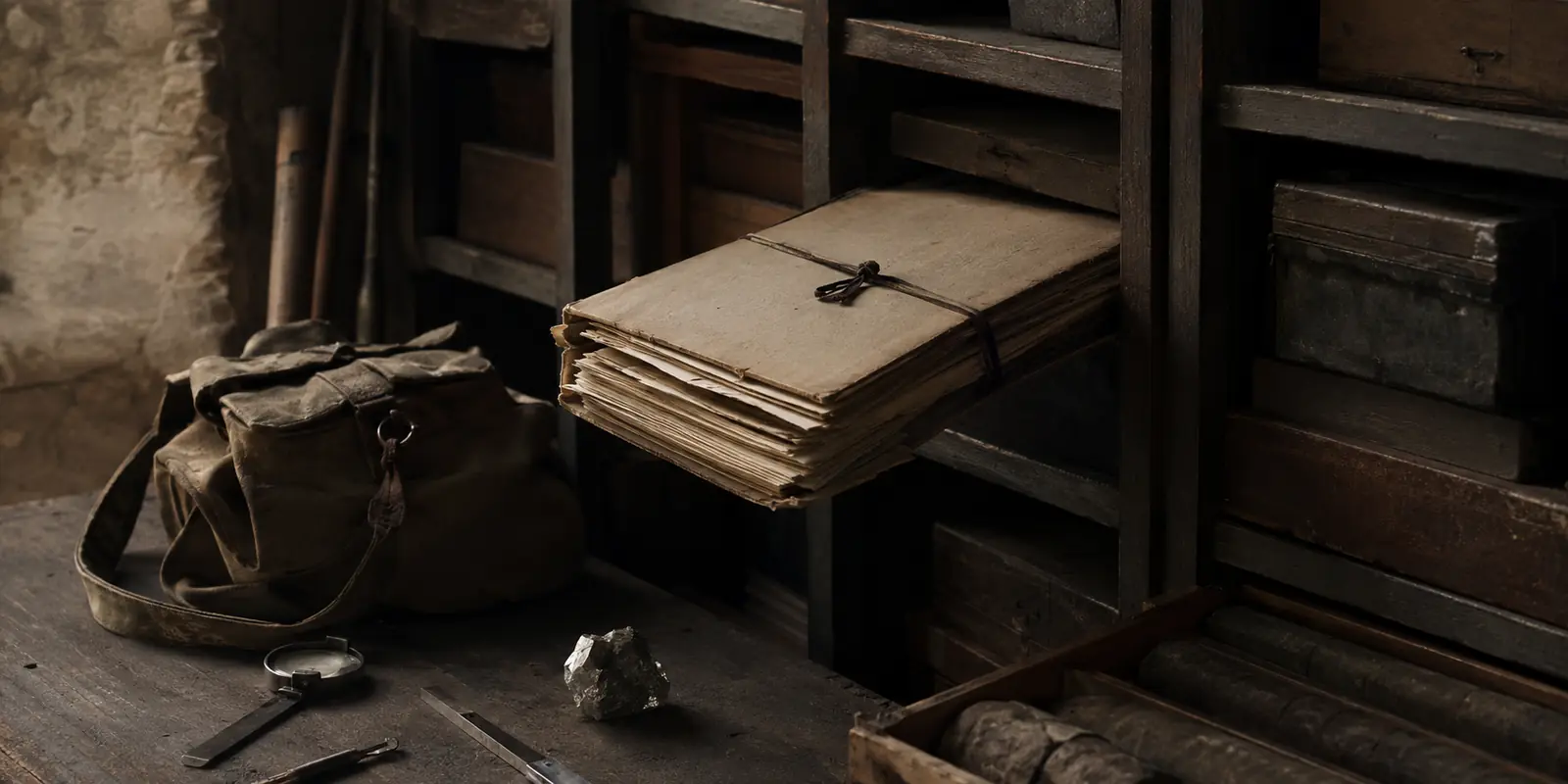
The district
Nobody was looking for antimony in 1987. It was a penalty.
Rampart Creek Resources Ltd. staked the Bittercreek block in 1985, in the tail of the gold run, chasing a quartz-vein target four kilometres up the drainage.1
They found stibnite instead.
Stibnite is the mineral antimony comes out of.2 It's also a pathfinder: where you find it, gold is sometimes near. So the crew logged it, boxed it, and kept drilling for the gold.
Antimony itself was a nuisance. Too little to sell, enough to cost you at the smelter.
Every antimony showing in the west had the same trouble in the eighties. Western smelters weren't buying concentrate at a dollar a pound, and a junior chasing gold had no reason to argue with them.
The best hole on the property was an inconvenience.
The recommendation
They closed the file in the fall and wrote four sentences about why.
Four of the nine holes had cut antimony over 1% across more than three metres. The best of them, BC87-05, ran 6.2 metres at 5.1% antimony from 112 metres.1
That is a high-grade antimony intercept by any standard, then or now.
The crew chief's recommendation was that the grades were real and the market wasn't.
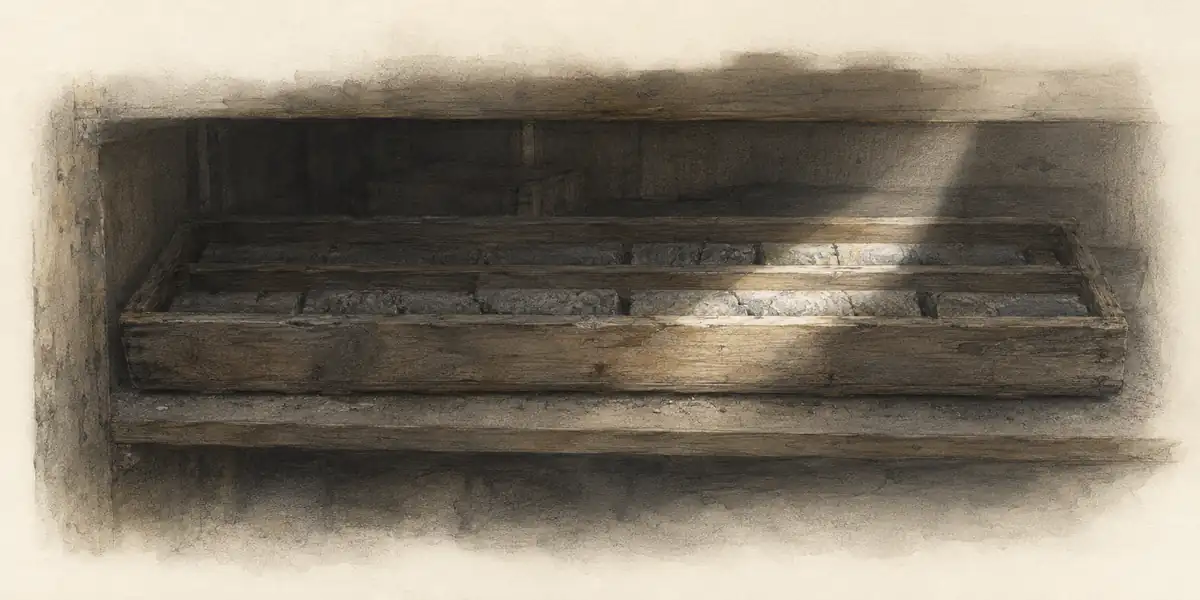
The core went to a yard in Watson Lake. The assessment report was filed. Nobody drilled the block again.1
Thirty-nine years is a long time for a property nobody argued about.
That was the correct call, and this page isn't going to pretend otherwise.
The check
The market agreed with him, in writing, the following year.
The US Bureau of Mines put antimony metal delivered in New York between $1.01 and $1.16 a pound in 1988.3
That's the published range from the agency whose job was publishing it, in the year after the crew walked away.3
Most companies would bury a document that says their property was correctly abandoned. We're linking it, because the same source is the reason to look again.
He was right, and we're the ones telling you so.
The arithmetic
Four numbers decide whether rock becomes a mine. A drill crew can only measure two.
How rich it is. How much of it there is. What it costs to get out. And what the metal sells for.
Six holes told them what came out of the core. They didn't establish continuity or tonnage.1
The rest was judged against the costs and the metal price of 1987, because those were the only costs and the only price anyone had.
Three of those four numbers are still open questions. The fourth moved.
The number
Now the number you're probably already reaching for.
By 2022 the annual average price of antimony had reached $6.18 a pound. In 2023 it eased to $5.60.4
Set that against $1.01 to $1.16 in 1988 and you can do the arithmetic without our help.3
You already have. Everybody does. It's the first thing anyone does with two prices and thirty-five years.
Run it if you like. We're not going to run it for you.
The honest part
Those are nominal dollars, and a nominal comparison across thirty-five years flatters us.
A 1988 dollar and a 2022 dollar aren't the same dollar. The USGS recasts old metal prices in constant dollars for exactly this reason.5
Adjusted, the move is smaller than the raw numbers suggest. It still runs in the direction that reopens the file.
The conditions that produced the 1987 recommendation are gone. What replaced them still has to be tested.
Both figures are nominal. A 1988 dollar and a 2022 dollar are not the same dollar, so the raw comparison overstates the move. We are not running the multiple.
The file
What's actually in the box in Watson Lake.
The 1987 program drilled nine holes, 1,940 metres.1
BC87-03 returned 11.6 metres at 3.4% antimony from 84 metres. BC87-05 returned 6.2 metres at 5.1% antimony from 112 metres. The two collars sit 240 metres apart.1
Those are core lengths. True widths are unknown, and five of the nine holes returned nothing worth writing down.1
The crew also mapped stibnite-bearing vein float along 1.4 kilometres of a single structure, which is why they kept drilling after the first hole came back barren.1
These are historic results. No Qualified Person has verified them, there's no current mineral resource on this property, continuity between the two holes has never been demonstrated, and no metallurgical test work has been completed.1
Who reopened it
We optioned the block in October 2025 and financed it in February 2026.
The file had sat with a private holder for thirty-eight years. Nobody had drilled it, nobody had re-logged it, and nobody had sent the pulps anywhere.6
We took the option, put C$4.6 million in the treasury, and started with the cheapest question on the list.6
Marcus Reyes, P.Geo. runs the program. He worked the Yukon antimony occurrences in the nineties, when nobody was paying for that experience.6
We're not the people who found this. We're the people who noticed the price.
What that buys
The market has us at less than the money in the bank.
38.4 million shares out. Insiders hold 22%. 1.9 million warrants at C$0.35, and no debt.6
Cash on hand is C$3.4 million. The market values the whole company at C$2.9 million.6
Which prices the Bittercreek option, the historic file and the program at less than nothing.
We're not going to defend that number. We're going to drill through it.
The ground
Yukon has antimony. The paperwork goes back sixty years.
The Yukon Geological Survey's own model for stibnite veins names a territorial example, catalogued as Becker-Cochrane.7
Somebody wrote a thesis on that showing in 1966. It sits in the Survey's library today.8
That showing isn't ours and we're not claiming it is. It's the reason a stibnite occurrence in this territory isn't a surprise.
Canada named antimony a critical mineral in 2021 and kept it on the list through the 2024 review. The test runs two ways: the supply chain has to be threatened, and Canada has to have a reasonable chance of producing the mineral itself.9
Canada ranked ninth in the world for mined antimony between 1998 and 2023. Its significant deposits no longer contribute much of anything.10
Read those two together and you'll see why an old file in Yukon is worth the freight.
Claim outlines, neighbouring holders, the drainage and the 1987 collars are all invented. The target outline is drawn around two holes; it is not a resource, a zone, or a measured extent of anything.
What changed
The rock didn't learn anything. Everything used to judge it has to be tested again.
Unchanged since 1987
The rock in the ground. The nine holes. The distance to anywhere.
Changed
The price context, and the policy environment the metal now sits in.
Has to be retested
The historic assays. Continuity between the holes. Recovery. What it costs to work the ground today.
The core is where they left it. The grade at Bittercreek is what it was in 1987, and so is the distance to anywhere.
One number moved far enough to put the other three back on the table. It didn't move because of us.
What the 1987 crew couldn't know is the only thing that's different: that a metal they were docked for would be on a critical minerals list, in a country with almost no production of it.9
What happens next
Phase One is 4,200 metres, and the first assays land in September.
Twin the two intercepts first. Then step out along the 1.4 kilometres of vein float the 1987 crew mapped and never tested.6
Metallurgy runs on the same core, because a grade you can't recover is a number in a report.
Whatever comes back, it goes out. Including the holes that miss.
The shaded lens is ground nobody has drilled. It marks where the program is aimed, not a mineral resource, and no volume or tonnage is shown or implied.
A file goes back on the shelf when the arithmetic says so. Nobody had run the arithmetic since 1987.
Don't take our word for the market around us. Take theirs.
The market numbers on this page came from sources with no reason to help us.
Frequently asked
Why was the property dropped in 1987?
Antimony was running around a dollar a pound. In 1988, foreign metal delivered in New York ranged from $1.01 to $1.16.3 At that price, nothing the crew found justified the cost of getting to it, and the operator was drilling for gold anyway.1
What's changed since 1987?
The price context. The USGS put the annual average at $6.18 a pound in 2022 and $5.60 in 2023.4 The rock and the old holes are unchanged, but recovery, continuity and what it costs to work the ground today all have to be tested again before any of it means anything.
Is the deposit worth six times more now?
No. Price is one of four variables, the comparison runs in nominal dollars rather than constant ones,5 and nothing at Bittercreek has been confirmed to a current standard. The changed price is a reason to ask the question again, not an answer to it.
Are the 1987 results a mineral resource?
No. They're historic results, not current resources under NI 43-101.1 Nobody should treat them as an estimate of anything.
Does Yukon actually have antimony?
Yes. The Yukon Geological Survey's own deposit model for stibnite veins names a territorial example, catalogued as Becker-Cochrane,7 and a University of British Columbia thesis described it in 1966.8 Bittercreek isn't that showing, and no claim is made that it sits near it.
What is antimony used for?
Stibnite is the ore mineral it comes out of.2 In the United States the leading uses are metal products including antimonial lead and ammunition, flame retardants, and nonmetal products such as ceramics, glass and rubber.4
How do I follow this?
You can't. Acme isn't real. If you want a page like this one for a company that is, the button at the top of the screen books a call.
Sources
| # | Carries | Source |
|---|---|---|
| 1 | The 1987 program, the operator, the claim block, and every result attributed to any of them | Fictional. The Bittercreek claim block, the 1987 drill program, and every result attributed to it. |
| 2 | Stibnite as the ore mineral of antimony | Antimony Statistics and Information. USGS National Minerals Information Center. |
| 3 | The 1988 New York price range of $1.01 to $1.16 per pound | Minerals Yearbook, Antimony. U.S. Bureau of Mines. Table 7, 1988 price ranges. |
| 4 | The 2022 average of $6.18/lb, the 2023 average of $5.60/lb, and US antimony end uses | Mineral Commodity Summaries 2024, Antimony. U.S. Geological Survey. |
| 5 | The constant-dollar method, and why a nominal comparison across 35 years overstates the move | Metals Prices in the United States through 1998. USGS. Constant-dollar method. |
| 6 | The option, the financing, the share structure, the treasury and the 2026 program | Fictional. Acme Demo Mining Inc. does not exist. No filing, no ticker, no people. |
| 7 | Becker-Cochrane as a documented Yukon antimony occurrence | Stibnite Veins and Disseminations, deposit model I09. Yukon Geological Survey Open File 2005-5. |
| 8 | The 1966 thesis on that showing | Hylands, J.J., 1966. Petrology and mineralogy of the Yukon Antimony stibnite deposit. University of British Columbia. YGS reference 44021. |
| 9 | Antimony's place on the Canadian critical minerals list and the two-part test for listing | Canada's Critical Minerals List. Natural Resources Canada, first released 2021, updated 2024. |
| 10 | Canada's ninth-place ranking and its deposits no longer contributing | Antimony in Canada: challenges and opportunities in resources, markets, and sustainability. FACETS, 2025. DOI 10.1139/facets-2025-0079. |