The split
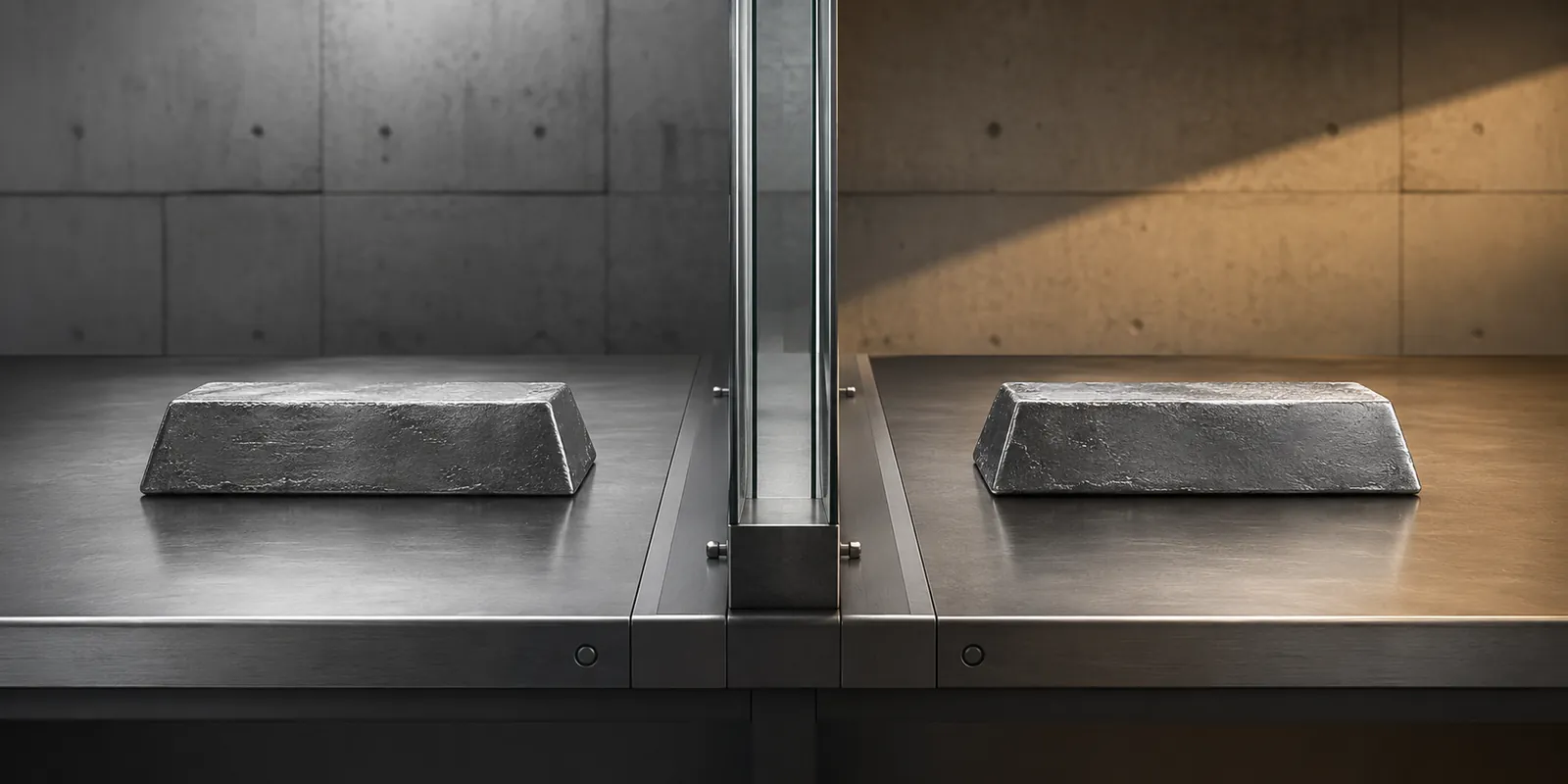
In September 2024 the price of antimony stopped being one number.
Before that there was a world price. Traders quoted it, smelters bought against it, and Rotterdam and Changsha were arguing over a few percent.1
Then China's export licensing tightened and the two halves came apart.1
They haven't come back together since.
A European buyer can still get antimony. He just has to pay a premium to get it from somewhere that isn't licensed out of Beijing, or wait on a licence that may or may not come.
That premium isn't a spread a trader arbitrages away. It's the cost of a second supply chain that mostly doesn't exist yet.
That is the market this property woke up into.
The scale
Roughly four tonnes in five come out of one country.
China mines about 80% of the world's antimony.2
There's no second supplier of that size, and no swing producer sitting on spare capacity waiting for the price to move.
Antimony goes into ammunition primers, flame retardants, lead-acid batteries, glass and ceramics.3 It's in a fire door and a car battery.
The US Geological Survey records that in 2023 the United States mined no marketable antimony at all.3
A metal you have never thought about, sourced from one place.
The hole in the map
Canada calls antimony critical. Canada mines almost none of it.
Antimony went on Canada's critical minerals list in 2021 and stayed on it through the 2024 review.4
The test for that list runs two ways. The supply chain has to be threatened, and Canada has to have a reasonable chance of producing the mineral itself.4
Between 1998 and 2023 Canada ranked ninth in the world for mined antimony. Its significant deposits no longer contribute much of anything.2
Read those last two together.
Canada listed the metal partly on the grounds that Canada could produce it. Then it didn't.
Nobody builds a mine for a metal worth a dollar a pound. The ground that might host one gets staked for something else and dropped, which is roughly the history of Bittercreek.
That's the gap the list was written to describe. A metal the country calls critical, with almost no domestic production standing behind the word.
Somebody has to be first back in.
The door
Three dates run this market. Beijing set all three.
- September 2024export licensing slows shipments and the world price splits in two.1
- November 9, 2025China's Ministry of Commerce suspends the ban on antimony exports to the United States.5
- November 27, 2026the suspension expires5
You can put that one in a calendar.
The buyer's problem
So what does a buyer in Rotterdam do on November 28?
He has known the date for a year. He has been paying the premium the whole time.1
Both benchmarks have come off the 2025 peak for two months running, and the split between them held anyway.1
The panic went out of the price. The structure stayed.
Panic prices bring out sellers, because for a month everyone with a warehouse is a supplier.
A split that outlives the panic brings out a different buyer: the one who's stopped trying to time it and started trying to source it.
A price spike brings out sellers. A split that survives the spike brings out buyers who want a different address to buy from.
We are an address.
Our ground
We hold a claim block in southeast Yukon with high-grade antimony already in the file.
We're Acme Demo Mining Inc. (DEMO: ACME).6 We hold the Bittercreek claim block, staked by Rampart Creek Resources Ltd. in 1985 and drilled in 1987.7
They were chasing gold. They found stibnite, which is the mineral antimony comes out of,8 and at a dollar a pound they wrote it off and moved on.7
Four of the nine holes cut antimony over 1%, the best of them 6.2 metres at 5.1% antimony.7 The core has been sitting in Watson Lake ever since.
Those are historic results. No Qualified Person has verified them, there's no current mineral resource, and continuity between the holes has never been demonstrated.7
Claim outlines, neighbouring holders, the drainage and the 1987 collars are all invented. The target outline is drawn around two holes; it is not a resource, a zone, or a measured extent of anything.
Why we could move
We optioned it in October 2025, financed it in February 2026, and had rigs turning by late May.
C$4.6 million raised, 38.4 million shares out, insiders holding 22%, no debt.6
Cash on hand is C$3.4 million against a market capitalisation of C$2.9 million.6
Two rigs are on the property now, fully funded out of the February raise, with first assays due in September.6
The metal moved in 2024. We were on the ground by 2026. Most of this sector is still writing memos.
That isn't clairvoyance. The 1987 file was public, the pulps were in storage, and the price had already done the work.6
What it took was being willing to option a property everyone else had written off, at a price that reflected how thoroughly they'd written it off.6
The ledger
Set the two prices side by side.
$23,000 in Europe. $15,940 in China. Same tonne, same day.1
A Western buyer faced those two prices on opposite sides of China's licensing regime.
No current drilling has demonstrated a tonne at Bittercreek.
We're telling you what the metal is worth and admitting we haven't proved we have any. Both of those are on this page on purpose.
Why now
Our program finishes before Beijing's clock does.
The suspension expires November 27, 2026.5
Our summer program at Bittercreek finishes before it does.7
We didn't set that date and we can't move it. We can be standing somewhere useful when it arrives.
If the twin holes come back at the 1987 grades, we'll say so. If they don't, we'll say that too, and this page will be wrong in public.6
Either way you'll know before November.
If the twin holes come back at the 1987 grades, we'll say so. If they don't, we'll say that too, and this page will be wrong in public.
A door with an expiry date printed on it is still a door. Beijing printed the date. We just read it.
Don't take our word for the market around us. Take theirs.
The market numbers on this page came from sources with no reason to help us.
Frequently asked
Why does Europe pay more for antimony than China?
Export licensing. China's controls split the market in two in September 2024, and on July 2, 2026 European material ran $23,000 a tonne against $15,940 inside China.1
Does the price gap mean antimony's going up?
No. Both benchmarks have fallen for two months running, off the 2025 peak.1 The gap between the two prices is a separate thing from the direction of either one.
Is China's export ban over?
It's suspended until November 27, 2026. China's Ministry of Commerce announced that on November 9, 2025, and a suspension can be withdrawn.5
How much of the world's antimony does China mine?
Roughly 80%.2
Is antimony a critical mineral in Canada?
Yes. Canada listed it in 2021 and kept it through the 2024 review. The test has two parts: the supply chain has to be threatened, and Canada has to have a reasonable chance of producing the mineral itself.4
Does Canada mine any antimony?
Barely. Canada ranked ninth in the world for mined antimony between 1998 and 2023, and its historically significant deposits no longer contribute much of anything to global supply.2
How do I follow this?
You can't. Acme isn't real. If you want a page like this one for a company that is, the button at the top of the screen books a call.
Sources
| # | Carries | Source |
|---|---|---|
| 1 | Both July 2, 2026 benchmark prices, the September 2024 split, and the two-month decline off the peak | Antimony price benchmarks, China domestic 99.65% Sb and European equivalent, 2 July 2026. Shanghai Metals Market (SMM-SB-AI-002). |
| 2 | China's share of global production, and Canada's ninth-place ranking with its deposits no longer contributing | Antimony in Canada: challenges and opportunities in resources, markets, and sustainability. FACETS, 2025. DOI 10.1139/facets-2025-0079. |
| 3 | Antimony end uses | Mineral Commodity Summaries 2024, Antimony. U.S. Geological Survey. |
| 4 | Antimony's place on the Canadian list and the two-part test for listing | Canada's Critical Minerals List. Natural Resources Canada, first released 2021, updated 2024. |
| 5 | The November 9, 2025 suspension and its November 27, 2026 expiry | Antimony 2026: ample supply, strategic demand. Fastmarkets, reporting the MOFCOM suspension of 9 November 2025. |
| 6 | The option, the financing, the share structure, the treasury and the 2026 program | Fictional. Acme Demo Mining Inc. does not exist. No filing, no ticker, no people. |
| 7 | The claim block, the operator, the 1987 program, and the summer program | Fictional. The Bittercreek claim block, the 1987 drill program, and every result attributed to it. |
| 8 | Stibnite as the ore mineral of antimony | Antimony Statistics and Information. USGS National Minerals Information Center. |