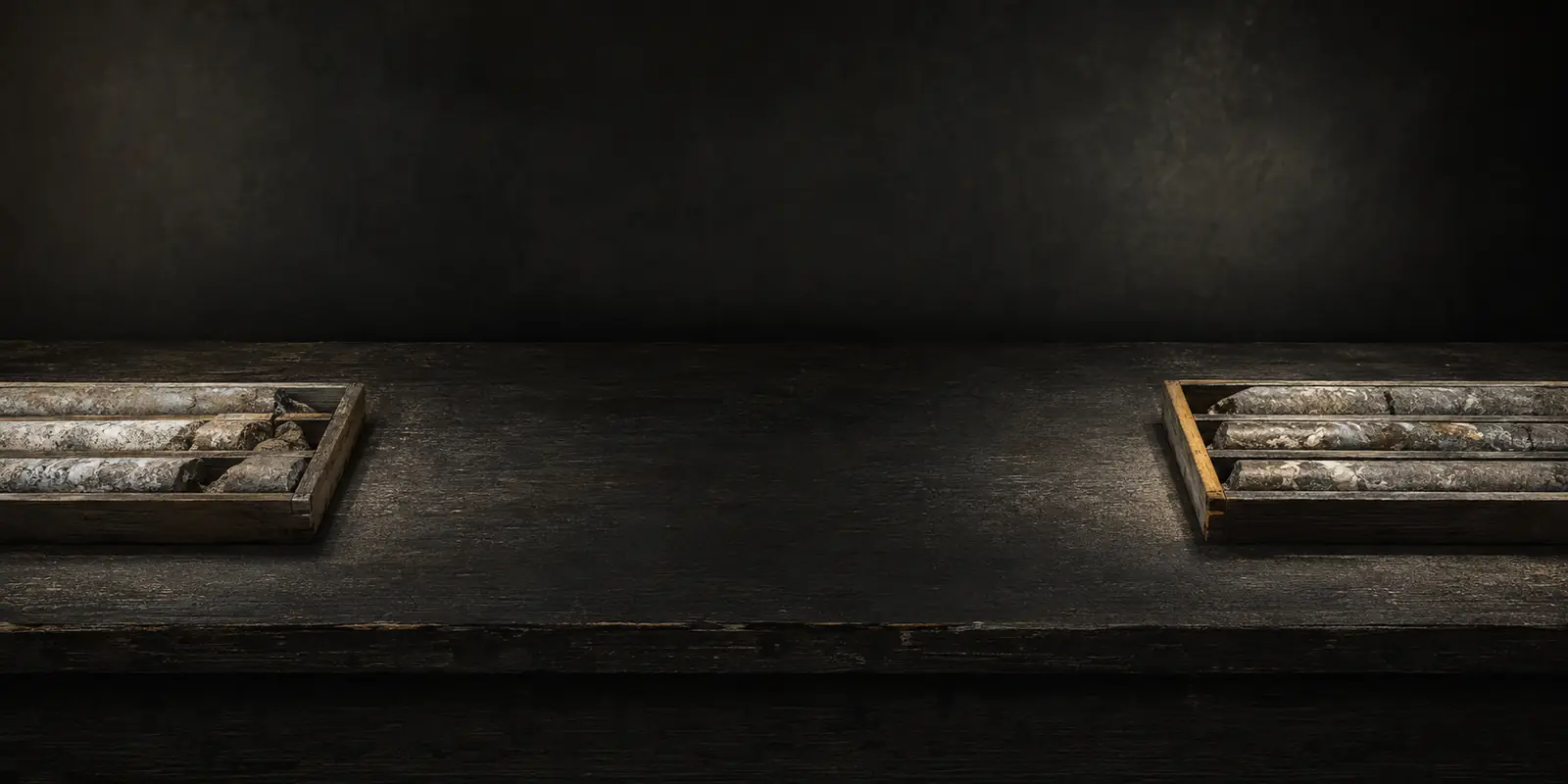
What's on the ground
The 1987 crew found high-grade antimony and walked away from it.
BC87-03 cut 11.6 metres at 3.4% antimony from 84 metres. BC87-05 cut 6.2 metres at 5.1% antimony from 112 metres.1
Those are strong antimony grades. Hillgrove in New South Wales, the largest antimony producer outside China, has run a mine on ore in that range for decades.
They mapped stibnite-bearing vein float along 1.4 kilometres of a single structure before they drilled.1
Then antimony sat at a dollar a pound and the file closed.2
The grade was never the problem. The price was.
What decides it
Grade, continuity, recovery. In 1987 nobody could answer any of the three.
Grade is the one with an answer already in the file.
Continuity asks whether the two intercepts are one thing.
Recovery asks whether the antimony will separate into a concentrate a smelter will buy.
One of those is now answered. The other two are what the rigs are for.
Question one, answered
We sent somebody else's samples to somebody else's lab.
The 1987 crew kept their reject pulps. They went into storage in Watson Lake with the core and they were still there.1
In 2025 we sent them to an accredited lab in Vancouver, under the lab's chain of custody rather than ours.1
We didn't select the intervals. We sent the box.
BC87-05 had been reported at 5.1% antimony in 1987.
It came back at 5.6%.1
One number, one hole, material somebody else collected thirty-eight years ago. It isn't a resource and we won't pretend it is.
What it is, is the cheapest of the three answered, by a party with no reason to help us.
What we flew first
Before we booked a rig we flew the block.
In March 2026 we flew 410 line-kilometres of drone magnetics over Bittercreek, low and tight enough to hold detail a fixed-wing survey smears.3
Magnetics doesn't find antimony. It finds structure, and structure is what a vein system sits in.
What came back is a linear magnetic low running 2.1 kilometres northeast through the block.3
The 1987 collars sit on it. So does the 1.4 kilometres of stibnite float the crew mapped at surface.1
That's a structure, not a deposit. It tells us where to drill, not what we'll find.
Question two
You are already connecting those two holes. We're not going to help.
It's the natural thing to do. Two intercepts, one plane, draw a zone between them and there's your deposit.
Continuity gets demonstrated with a drill. Ours hasn't been.
Five of the nine 1987 holes returned nothing worth writing down. That's the same dataset, and it argues the other way.1
The space between the holes is the property. Everything else is paperwork.
The dashed structure is an interpretation, not a measurement. Nothing has been drilled between the two intercepts and continuity between them has not been demonstrated.
The dashed outline is the ground between the two intercepts. Nothing has been drilled inside it, and the magnetic low is a structure, not a deposit.
Question three
Nobody has ever checked whether this material makes a concentrate.
Grade in the ground isn't metal in a bag. Stibnite has to be liberated, floated and cleaned to a concentrate a smelter will take, at a recovery that pays for the work.
No metallurgical test work has been completed at Bittercreek.1
A 2025 review of antimony in Canada names recovery method as one of the three things that make this metal difficult.4
If the flowsheet fails, the grade doesn't matter and neither does the price.
Underway now
What's happening on the property this month.
Two rigs have been turning at Bittercreek since late May. The program is 4,200 metres, fully funded out of the February raise.1
The first holes twin BC87-03 and BC87-05 under a modern QA/QC protocol. That answers whether 1987 was right.
The rest step out along the 1.4 kilometres structure. That starts to answer whether there's anything between the holes.
Core from the twins goes straight to metallurgical test work rather than waiting for the drill season to finish.1
First assays in September. Flowsheet results in November.1
The order of work
Cheap questions first.
Twinning is cheap. A hole beside a hole tells you whether 1987 was right for the price of a few hundred metres.
Step-out drilling is expensive, and it's worthless if the thing you're stepping out from was never real.
Cheap questions first. Expensive ones only if the cheap ones hold.
What's at stake
So why is this worth drilling now and not in 1987?
Antimony went on Canada's critical minerals list in 2021 and stayed on it through the 2024 review. The test runs two ways: the supply chain has to be threatened, and Canada has to have a reasonable chance of producing the mineral.5
Canada ranked ninth in the world for mined antimony between 1998 and 2023. Its significant deposits no longer contribute much of anything.4
In 2023 the United States mined no marketable antimony at all.6
China's export suspension runs to November 27, 2026.7 Our flowsheet results land before it does.1
The rock is the same rock. Everything around it changed.
In short
High grade, an untested gap, and a program built to close it.
We're Acme Demo Mining Inc. (DEMO: ACME).3 We hold 1.4 kilometres of a stibnite structure in a country that calls this metal critical and barely mines any of it.5
One of three questions is answered and an accredited lab answered it. Two rigs are working on the other two.1
You've read the strongest version of the argument against this property, sourced, on the company's own page. Most companies make you go and find that yourself.
We won't draw a line between two holes and ask you to call it a deposit. We're drilling the space between them, and we'll publish what comes back.
Don't take our word for the market around us. Take theirs.
The market numbers on this page came from sources with no reason to help us.
Frequently asked
What is Acme drilling right now?
A 4,200 metres program with two rigs, running since late May and fully funded out of the February raise.1 The first holes twin the two 1987 intercepts; the rest step out along the 1.4 kilometres structure.
When do results come out?
First assays in September, metallurgical results in November.1 Both land before China's export suspension expires on November 27, 2026.7
What did the 2025 re-assay actually show?
One historic pulp from BC87-05, reported at 5.1% antimony in 1987, returned 5.6% at an accredited lab under the lab's own chain of custody.1 That supports the historic assay. It says nothing about continuity, tonnage or recovery.
Has metallurgical test work been done at Bittercreek?
Not yet. Core from the twin holes goes to test work as it comes out of the ground, with results expected in November.1
What makes antimony deposits difficult to develop?
Three things, per a 2025 review of antimony in Canada: high-grade concentrations are rare, economically viable stibnite deposits are generally small and discontinuous, and occurrence, grade and recovery can all be difficult.4
Does antimony have substitutes?
Yes. The USGS lists selected organic compounds and hydrated aluminum oxide as flame-retardant substitutes, and chromium, tin, titanium, zinc and zirconium compounds as substitutes in enamels and paint.6 Recycling supplied about 18% of United States apparent consumption in 2023.
Are the 1987 intercepts a mineral resource?
No. They're historic results, not current resources under NI 43-101,1 and continuity between the holes hasn't been demonstrated. That's what the drilling is for.
How do I follow this?
You can't. Acme isn't real. If you want a page like this one for a company that is, the button at the top of the screen books a call.
Sources
| # | Carries | Source |
|---|---|---|
| 1 | The 1987 program, the surface float, the surviving pulps, the 2025 re-assay, and the 2026 drill program and its timing | Fictional. The Bittercreek claim block, the 1987 drill program, and every result attributed to it. |
| 2 | The 1988 New York antimony price range | Minerals Yearbook, Antimony. U.S. Bureau of Mines. Table 7, 1988 price ranges. |
| 3 | The option, the financing, the share structure, the treasury and the 2026 program | Fictional. Acme Demo Mining Inc. does not exist. No filing, no ticker, no people. |
| 4 | Deposit character, exploration and processing difficulty, and Canada's ninth-place ranking | Antimony in Canada: challenges and opportunities in resources, markets, and sustainability. FACETS, 2025. DOI 10.1139/facets-2025-0079. |
| 5 | Antimony's place on the Canadian list and the two-part test for listing | Canada's Critical Minerals List. Natural Resources Canada, first released 2021, updated 2024. |
| 6 | Substitutes, the recycling share, and no US mine production in 2023 | Mineral Commodity Summaries 2024, Antimony. U.S. Geological Survey. |
| 7 | The November 27, 2026 expiry of China's export suspension | Antimony 2026: ample supply, strategic demand. Fastmarkets, reporting the MOFCOM suspension of 9 November 2025. |